Józef Piłsudski's speech in the Sejm, 10 February 1919
The English text below is our own translation of the Polish original.
Text of the speech
A century and a half of struggles, often bloody and full of sacrifice, has found its triumph today. A century and a half of dreams of a free Poland has awaited its fulfilment in this moment. Today is a great holiday of the nation — a holiday of joy after a long, hard night of suffering.
In this hour of the great beating of Polish hearts I am happy that the honour has fallen to me of opening the Polish Sejm, which will once again be the sole master and host of its native home.
Our neighbours, with whom we would wish to live in peace and concord, do not want to forget the age-old weakness of Poland, which for so long lay open to invasions and was the victim of a foreign will imposed on her by violence and force.
We do not want to interfere in the internal life of any of our neighbours, but we cannot allow our right to an independent life to be violated under any pretext whatsoever, even under the pretext of a supposed benefaction.
We shall not give up a single span of Polish soil, and we shall not allow the borders to which we have a right to be diminished.
The aspirations of our neighbours have brought it about that we now find ourselves in open war with all of them, or at the very least in severely strained relations.
The bright side of our external relations is the tightening bonds of friendship with the Entente powers. A deep sympathy has long united Poland with the democratic world of Europe and America, which does not seek glory in conquests and the oppression of other nationalities, but desires to order relations according to the principles of justice and right.
That sympathy grew stronger when the glorious armies of the Allied powers, shattering the last might of our oppressors, freed Poland from bondage.
I am convinced that cordial feelings and an undeniable community of interests with these powers will make substantial and effective help on their part a necessity for us.
Analysis
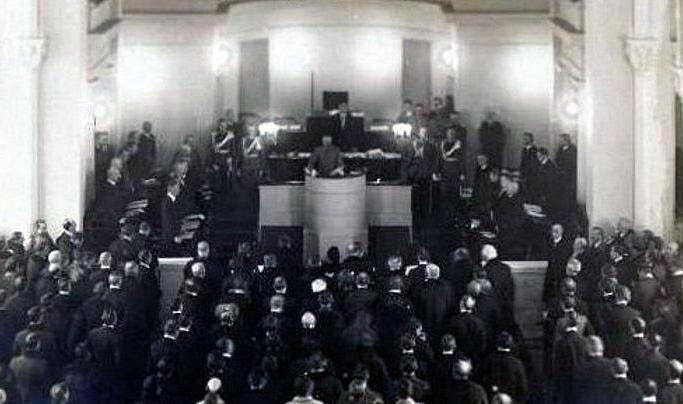
of the Legislative Sejm, 1919
Introduction
A century and a half of struggles, often bloody and full of sacrifice, has found its triumph today. A century and a half of dreams of a free Poland has awaited its fulfilment in this moment. Today is a great holiday of the nation — a holiday of joy after a long, hard night of suffering.
In this hour of the great beating of Polish hearts I am happy that the honour has fallen to me of opening the Polish Sejm, which will once again be the sole master and host of its native home.
Body
Our neighbours, with whom we would wish to live in peace and concord, do not want to forget the age-old weakness of Poland, which for so long lay open to invasions and was the victim of a foreign will imposed on her by violence and force.
We do not want to interfere in the internal life of any of our neighbours, but we cannot allow our right to an independent life to be violated under any pretext whatsoever, even under the pretext of a supposed benefaction.
We shall not give up a single span of Polish soil, and we shall not allow the borders to which we have a right to be diminished.
The argument set out next starts from the premise "there are neighbours (other countries) who remember that Poland was historically weak". Therefore:
- The borders must not be allowed to be diminished
- The sons of the Fatherland must go to defend its borders
Argument
Present information that supports main points of your speech.
If a speech contains a thesis, this thesis must be supported by arguments.
Arguments can refer to different modes of persuasion - Aristotle pointed out three: pathos (simply put, emotions), ethos (simply put, your credibility and authority) and logos (data, logic - or tricks merely imitating logic).
It's worth to mention that arguments do not need to be logic-based in a formal sense. A good rule of thumb is the ARG rule (described by Trudy Govier) which says that an argument can be deduced from premises that meet the following criteria:
- are acceptable to the audience (they refer to common knowledge, topics or in any other way are hard to falsify)
- refer to a main premise which we want to prove with our argument (as a counterexample: Poland does not need to introduce Euro because China does not have the currency and experiences economic growth - both countries are unrelated to each other)
- together all premises give a satisfactory ground to persuade audience that the main premise is also true (as a counterexample: all people I know earn less money than the average, so the average must be wrong)
We recommend constructing arguments that use logic to infer some premise from statistics, data, and research - if that research was conducted in an impartial manner to minimize error (for example, by using scientific method).
At the same time, a well-narrated anecdotical evidence that taps into emotions can be of similar strength (in reception) to a logical argument. However it depends strongly on the target audience. Appeals to authority are similar in this perspective.
A decision which arguments and which types of arguments should be chosen depends on the goal, message, audience expectations. If the audience needs to make a decision on their own, it's desired to put more data and logical arguments. If the speech should motivate people to do some action, arguments relying on personal stories and emotions can persuade audience.
See also: argument with omitted preposition, argument from deduction, simple conclusion, present a fact.
The aspirations of our neighbours have brought it about that we now find ourselves in open war with all of them, or at the very least in severely strained relations.
The bright side of our external relations is the tightening bonds of friendship with the Entente powers. A deep sympathy has long united Poland with the democratic world of Europe and America, which does not seek glory in conquests and the oppression of other nationalities, but desires to order relations according to the principles of justice and right.
That sympathy grew stronger when the glorious armies of the Allied powers, shattering the last might of our oppressors, freed Poland from bondage.
I am convinced that cordial feelings and an undeniable community of interests with these powers will make substantial and effective help on their part a necessity for us.
Call to action
Persuade and empower your audience to take action.
This element will typically be used in your conclusion. It is here that you paraphrase your whole speech into actionable points for your audience to follow. The speech up to this moment was explaining problems and possible solutions, but at this moment you are going to put the tools into the hands of your audience. You can call to do a specific thing, to stop doing a specific thing or to maintain status quo.
How to end with call to action? E.g.:
- Self-reference your opening statements.
- Make an example - I'm already doing that. Will you?
- With a simple anecdote that visualizes what would happen if we started doing the action now (or in near future).
- Presenting data in memorable format - If all of us spent one less minut with lights on...
Focus on the power to spread the idea by using memorable, short sencences. Consider answering the question: What your audience should tell somebody who does not know anything about the topic?
Simple conclusion / Conclusion chain
A direct conclusion frawn from a single premise. Allows for chaning premises.
Also known as signum.
A few conclusions following one another construct a chain of conclusions (sorites - a stack in Latin). These allow to gradually transform one premise into another in a way that is understandable for audience and avoid mental shortcuts.
Note that a chain is only as strong as its weakest link, so try to draw only strong conclusions that cannot be simply refuted. It's like multiplication of probabilities - one in two times one in three makes the whole only one in six. A chain of conclusions grows weaker with all of its weak claims and may result in you being perceived by your audience in a bad light.
Example: We've seen a smoke from a couple of streets away from here. There's probably a fire in there (conclusion). There might be people that need help (conclusion). Let's go there and find out (conclusion).
Conclusions are drawn from one premise and because of that these are simple and can be condensed in time.